
Low-cost learning test
Product, fulfillment time, follow-up, possible sample cost.
Gifting
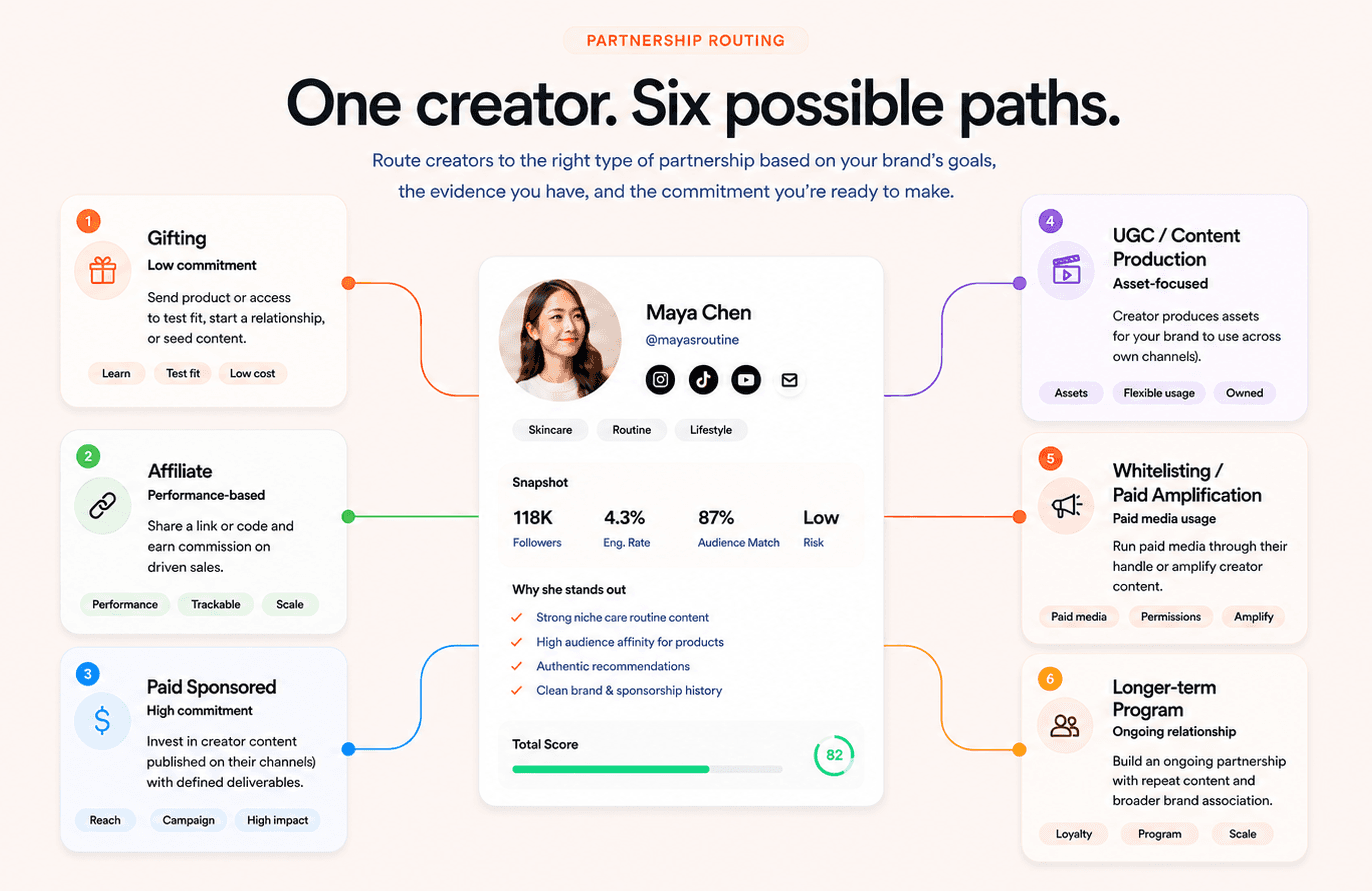
A practical routing framework for deciding whether an approved creator should move into gifting, affiliate, paid sponsored content, UGC, whitelisting, or a longer-term program.
Creator review often gets stuck after the team agrees that a creator looks promising. In practice, the gifting vs affiliate vs paid influencer decision is where teams either protect budget and learn faster or overcommit too early. Your team needs to decide what kind of partnership makes sense: gifting, affiliate, paid sponsored content, UGC, whitelisting, or a longer-term program. Each model carries a different level of cost, risk, operational work, rights complexity, and expectation, so the path should match the evidence you already have.
Gifting means the brand sends product or access, usually to test fit, start a relationship, or seed a potential content path. It works best when the creator's content is relevant, the product can be fulfilled easily, and the team does not need a guaranteed deliverable.
Affiliate means the creator receives a link, code, commission structure, storefront path, or performance-based offer. It works best when the creator has buyer-intent signals, strong category relevance, or existing customer affinity.
Paid sponsored content means the brand is committing budget for defined deliverables, timelines, approval steps, and campaign placement. Paid work needs stronger review notes because the cost and stakeholder visibility are higher.
UGC or content production means the creator is primarily producing assets for the brand to use, often without relying on the creator's own audience distribution. This model works best when the creator has strong production quality, a clear product use case, and terms that cover editing, usage, and ownership expectations.
Whitelisting or paid amplification means the brand may run paid media through the creator's handle or amplify creator-made content through paid channels. This model needs extra review around brand fit, claims, audience context, permissions, usage windows, and how the asset will appear once media spend is behind it.
Longer-term or ambassador programs mean the creator may become part of an ongoing relationship instead of a one-off activation. This path needs evidence that the creator can show up repeatedly for the category, not just make one strong post.
Internal statuses such as pause, hold, or stakeholder review still matter, but they are not partnership types. Use them to manage timing, missing information, or approval ownership around the partnership model.
Disclosure requirements differ by partnership model. Paid sponsored content and affiliate partnerships require clear material-connection disclosures. Gifting without a posting expectation can look less formal, but any gifted content that becomes a recommendation post still needs proper disclosure in most markets.
In real creator programs, partnership models can combine. A brand might start with gifting plus an affiliate code, or pair paid sponsored content with whitelisting rights when the asset will also support paid media.
Imagine a skincare brand reviewing four inbound creators.
| Creator scenario | Evidence | Partnership model |
|---|---|---|
| A smaller creator posts detailed skincare routines and gets comments about ingredients, but has limited sponsor history | Strong category relevance, useful comment quality, uncertain commercial proof | Gifting or affiliate test |
| A creator is a current customer with a small but active audience and frequent product recommendation posts | Existing brand affinity, plausible buyer context, low content risk | Affiliate |
| A larger creator has polished beauty content, clear sponsored examples, no recent competitor conflict, and a proven sensitive-skin angle from smaller tests | Strong creative fit, stronger paid readiness, validated message | Paid sponsored content |
| A creator has strong product demos but limited audience proof | Useful creative skill, uncertain distribution value | UGC brief before paid distribution |
No partnership model is inherently better than another. It's all about matching the marketing teams goals with their availalbe influencer pool.
There are typically three problems you run into if you're not specifically vetting creators for defined partnership types.
First, teams overpay too early. A creator with a polished profile may receive a paid offer before the team has checked whether the audience is relevant, whether recent comments show buyer interest, or whether the creator can make the product feel natural.
Second, teams underuse strong lower-commitment or non-distribution partnership models. A creator with good category fit but limited performance proof may be a strong product seeding, affiliate, UGC, or narrow paid test. If the only internal category is paid campaign, the team may miss a better first path.
Third, reviewers leave useless notes. A creator ends up in a spreadsheet as maybe, good fit, or circle back. The next person has to reopen the profile, rebuild the context, and make the same call again.
Routing should reduce that waste. The review note should explain what the team saw, what is still uncertain, and which next action matches the evidence.
Gifting works best when the team wants to test fit without making a paid commitment.
Good gifting candidates usually have:
Gifting is weaker when the creator appears to want guaranteed paid work, cannot use the product naturally, sits outside the shipping region, or has a recent competitor conflict that makes timing awkward.
For ecommerce brands, gifting should still be assigned with care. Product cost, fulfillment work, and follow-up time are real resources. A gifting partnership should explain why the creator deserves a sample and what the team expects to learn.
Useful note:
Relevant routine content and clear product use case. Ship sample if audience geography is in range. Review response before considering paid.
Bad note:
Gift?
The first note gives the next reviewer a reason and a condition. The second note creates more work.
Affiliate works when the creator has signs that the audience may act on a recommendation.
Useful signals include product questions in comments, prior recommendation behavior, customer affinity, category expertise, newsletter or storefront activity, and content that explains products clearly.
Affiliate can also fit creators who are already customers. Existing product familiarity can make the recommendation more credible, as long as the audience and content context still support the brand's goal.
Route to affiliate when:
Affiliate is weaker when the creator has little buyer context, unclear audience relevance, or content that does not make product recommendations believable.
Paid partnerships need the clearest review notes because they carry the most commitment.
A paid partnership should usually require stronger evidence across:
Paid can make sense for a creator with a smaller audience if the fit is clear and the campaign needs high-quality content, not just reach. It can also make sense for a larger creator when the audience and creative path are strong enough to justify the cost.
For larger creators, the creative angle should already be clear. The team should know which customer profile the creator is meant to reach, which product message they should carry, which objection they need to answer, and why the content format fits the campaign. If those inputs are still unsettled, start with a smaller creator test, UGC brief, or affiliate path before committing larger budget.
Write the paid sponsored content note as if another stakeholder will read it later. Include the campaign reason, the evidence that supports the partnership model, and any open conditions.
Example:
Strong fit for paid sponsored content. Recent content already explains morning routine and product comparison clearly. Comments include product questions. No direct competitor in the last 90 days. Confirm usage rights and timeline before offer.
That note gives the team a path to the next conversation.
Before moving a creator into paid, ask:
If those answers are weak, use a lower-commitment partnership model, a narrower UGC brief, or a smaller test before a larger paid commitment.
UGC and whitelisting are different from a standard sponsored post because the brand is usually thinking about asset use, paid distribution, or content rights.
UGC can make sense when:
Whitelisting or paid amplification can make sense when:
These paths need more documentation than a simple gifting test. The review note should explain how the content will be used, not only why the creator is relevant.
Useful note:
Strong short-form product demos and clear skin texture closeups. Consider UGC brief for launch ads. Do not whitelist until claims language and usage window are reviewed.
Smaller creators can be useful testing partners because the commitment is lower and the learning loop is faster.
Use gifting, affiliate, UGC, or narrow paid tests to learn which product angles, customer profiles, hooks, objections, and content formats deserve more budget. A smaller skincare creator might help the team test whether sensitive-skin messaging, morning-routine placement, ingredient education, or before-and-after content creates the strongest response. A home goods brand might use several smaller creators to compare apartment renters, new homeowners, gift buyers, and design-focused shoppers before building a larger campaign.
That learning should be documented. A good review note should capture what the team is testing, what signal would count as useful, and what the next partnership model would be if the signal is strong.
Example:
Test affiliate path with sensitive-skin angle. Watch for product questions, save/share behavior, and objections around price. If response is strong, consider paid sponsored content with a larger creator using the same angle.
Larger and more expensive creators should usually come later in the learning process. Use them when the team already has more confidence in the customer persona, product message, creative angle, offer, and approval requirements. A larger creator can amplify a proven angle, but they are an expensive place to test unproven angles.
If your team is still building intake, start with the best questions to ask on a creator application form. If your queue is already full, use how to prioritize influencer applications. For the manual profile review before routing, use the creator vetting checklist.
Choosing the right partnership model can be make or break for an influencer campaign. Use gifting when the creator is relevant but still unproven. Use affiliate when there are buyer-intent or customer-affinity signals. Use paid sponsored content when the evidence is strong enough to justify budget, deliverables, and stakeholder attention. Use UGC or whitelisting when the main question is how the brand will use the content, where it will run, and what rights or approvals are needed.
Smaller creators are often the right place to test angles, personas, offers, and product messages. Larger creators are usually better for scaling what the team already understands.
Threshold helps teams connect creator scoring to actual campaign selection. Use this framework to make the gifting vs affiliate vs paid influencer decision explicit in every review note, then move each approved creator into the next partnership model with a clear reason, a clear owner, and a clear follow-up step.
Before choosing the route, identify what the brand is actually committing. This keeps the partnership path aligned with the cost, rights, review work, and confidence required.
Low-cost learning test
Product, fulfillment time, follow-up, possible sample cost.
Gifting
Performance-aware test
Tracking setup, commission terms, link or code monitoring.
Affiliate
Budgeted campaign placement
Budget, deliverables, approvals, timeline, stakeholder attention.
Paid sponsored
Asset production
Creative brief, product access, editing expectations, usage terms.
UGC
Paid media usage
Permissions, usage rights, claims review, media spend.
Whitelisting
Ongoing relationship
Repeated product use, relationship management, broader brand association.
Longer-term program
Basic filters remove obvious no-fits. Manual review focuses attention on the creators who need judgment.
Submitted
Approved pool
64
Eligible
Basic fit confirmed
41
Manual review
Needs judgment
19
Routed
Next path selected
14
FAQS
Gifting usually fits creators with relevant content, plausible audience fit, and enough uncertainty that a lower-commitment test makes more sense than a paid commitment.
Affiliate can fit creators whose comments, content, customer affinity, or past recommendations suggest buyer intent, especially when the brand wants a performance-aware path before paid work.
Paid partnerships need stronger evidence: clear content fit, relevant audience response, reliable production, reasonable sponsor context, defined deliverables, and a campaign goal that justifies the cost.
Keep the creator in the approved pool with a clear note. They may fit a future launch, a narrower gifting test, a UGC brief, an affiliate path, or a different product line better than the current campaign.
Teams can automate intake completeness, basic eligibility, status movement, and reminder workflows. Humans should still review brand fit, content context, risk, sponsor conflicts, and close calls.
SOURCES
RELATED RESOURCES
Learn how to prioritize influencer applications with a tiered review system based on fit signals, not submission order.
Use these creator application form questions to collect useful information for influencer intake, operations, review, and decision making.
Use this creator vetting checklist to review fit, audience quality, sponsor context, and risk before your team approves DTC creator partnerships.
Threshold helps teams turn scattered creator signals into clearer review decisions.